Showing posts with label linguistics. Show all posts

09 February, 2014

Are you feeling cold?

My first week in Alakpeti has gone well. I'm in very good hands with my homestay family here and I am settling in, meeting more people, and slowly learning the language. The paramount ruler has now officially introduced me to the local rulers, elders, and queen mothers and they have officially welcomed me in their midst.
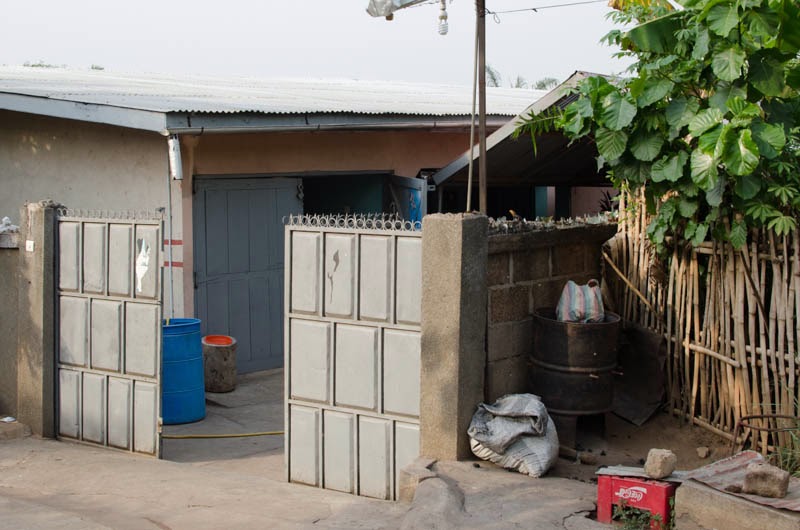
The entrance to my family's compound. The solid wood fufu mortar is next to the blue rain barrel (with an orange dish in it).
With the approval from the top level and the next level down, I will now be traveling to each of the Logba towns and villages (letting each one know when I'll be coming in advance) to meet with the people who have expressed interest in working with me. This will be the start of what is more conventionally considered to be 'language documentation' (of course, all of the preparation leading up to this is also an extremely important part of the work and is not to be dismissed as trivial! Planning, preparation, permissions, and getting to know people to a point of mutual trust and respect are also crucial to the work).
The view from across my family's cassava (and other things) garden to one of the peaks in the mountain range. The large palms are oil palms. I had palm fruit soup today with banku for lunch. The fronds are used for weaving and making hand-held brooms. The sap is tapped for palm wine and then distilled to make a local liquor (akpeteshie).  The fruit and nut are used for soup and oil. The oil can be used in making soap and 'red-red:' fried ripe plantains (which are red) with beans in palm oil (which is also red) - I had this for breakfast this morning. I have read that the husks of the fruit were previously charred and used to flavor water kept in tall ceramic containers with bulging bases and narrow necks (I would venture a guess that this maybe also contributed to purification of the water, but I am not an expert in this). The roots are used medicinally.
These are pretty powerful plants!

Since not (quite) all of my friends are linguists (I swear I have broad interests! Luckily, so do the bulk of my linguist friends), what is language documentation?

-eye stretch break-
Let me just pause for a second to admire the fact that about sixty feet outside my window a very large tree is blooming with triangular tufts of pink flowers. It is absolutely gorgeous!

Okay, language documentation is the documentation of language! This can involve written notes, audio recordings (on wax cylinders, as used to be done, or on SD cards, as is now becoming more common), video recordings (sign language research and gesture research make excellent use of this), and photographs to give context and visual referents. As we learned in the Plants Animals Words 2013 workshop, for plants a voucher specimen and botanical identification are also very important, and identifying animals can involve many things besides careful photographs, for instance information about behavior, flight patterns and wing shape (for birds), coloration, and scat.

Language is a powerful tool and it can be used to describe a diversity of experience in the natural (and supernatural!) world. Linguists are trained in many things, but by celebrating our own expertise and acknowledging our limits, we can benefit greatly from teaming up in a collaborative framework with many other experts, both from within the community in a participatory framework and also across disciplines in an interdisciplinary framework.

-ear break (do ears need to be stretched like eyes?)- 
There is a chorus of at least three completely different types of birds singing outside my window right now! And I think I hear my family preparing fufu...

Language documentation also includes a lot of metadata, which is information about the data, such as the names of those involved, how they were involved, the location, time, date, topic, equipment used, the languages included, and just about anything else you can think of to note that might be relevant either now or in the future. After my job working in the Endangered Languages Archive and going through the MA program in Language Documentation and Description, I now joke that, "I'm really not a fan of labels - but I do like metadata!"

Quick facts:

  • Not everyone who does language documentation is working with an endangered language. You can document languages considered stable or dominant, as well.
  • Not all languages are spoken. There are also sign languages, many of which are highly endangered. And there some amazing researchers whose focus is on documenting or advocating for these.
  • Not everyone who does language documentation is an 'outside researcher.' There are a growing number of people who are speakers (or heritage speakers, whose parents or grandparents may have been speakers even if they themselves are not fluent) of the language they are documenting. 
As for myself, I am definitely in the first camp, and this obviously has implications for the work I am doing. Though I have been invited to do this work by the paramount ruler, have been welcomed by the local rulers, and have been adopted into the royal family by the paramount ruler and his wife (four years ago), I am still an outsider in many many ways. I was not raised in the Logba Traditional Area, let alone in Ghana. I am still learning to speak the language (though as I keep trying, people tease me that I am already an "Akpanadze" or [female] Logba citizen). And my skin color is obviously very different, and with it comes all sorts of connotations. So I acknowledge this as I do my work and am educating myself on critical ways of approaching my research. I welcome critique from those with other perspectives and experiences than my own.

-smelling break! (don't 'break' your nose)- 
Outside my family's compound there are several sweet smelling trees, including Frangipani (Plumeria spp.) and also this one, which I believe is Ylang Ylang (Cananga odorata). In the evenings when there is a breeze its lovely scent wafts throughout the compound. I keep a few crushed up flowers by my bed.

Ylang Ylang tree (Cananga odorata) just outside my family's compound. In the evenings we often sit in chairs out here to enjoy the cool breeze and visit with neighbors who pass by.
Fruit of Cananga odorata
Flower of Cananga odorata.

I leave you now with a few more observations:

Women in transportation
In Accra just before I left, I rode for the first time in a trotro which had a female 'mate!' (Well, aside from the time in Kumasi when the mate was taken away by the police [both smiling and joking with each other] for trying to steal passengers from another trotro at a busy stop and my classmate, Rachel, happily took on the role of mate for the rest of the journey.) The mate is the person who calls out the destination of the trotro, collects money, and tells the driver when to 'bus stop' and then 'yenko!' ('Let's go!'). I also recently was beeped at by a female taxi driver - again, the first I'd seen in Ghana. Beeping at someone with your horn is usually a question, accompanied by a questioning hand gesture, meaning, 'Need a lift?' It is most frequently directed at those who look like the can afford a taxi, such as anyone in a suit or anyone who looks foreign (or exhausted by the heat!).

The cold
Up until recently I had never heard a Ghanaian in Ghana swear (at least not in English). What caused this sudden need for expletives? I was being told of the person's trip to London and how cold it had been! So cold that it made your hair stand on end. So cold that you had to wear thick socks under your shoes. So cold that you had to wear a warm hat with only your eyes and nose sticking out, and three layers of shirts with a jacket! -expletive expletive-

In contrast:
I was recently asked one evening, "Are you feeling cold?" (I was wearing shorts, a tank top, and sandals, and quite enjoyed the breeze!)
I couldn't help but laugh and laugh, then managed to reply, "I've just come from London!" Everyone joined me in laughter. They insist that if I wake up at 4:30am and go outside it will feel "cold like London!" but I've not yet tested this.

Okay my dears, that's all for now!

18 January, 2010

Logba/Ikpana

For anyone interested in hearing what the language Logba/Ikpana sounds like, listen to Peter Ladefoged's two recordings at the UCLA phonetics lab archive here: http://archive.phonetics.ucla.edu/Language/LGQ/lgq.html. The recordings were made in 1962 and are of a male speaker from Logba Tota (the top of the mountain). Speakers in Logba Tota reportedly have the most pronounced dialectal differences.

Also, the grammatical description of the language which was written by one of my advisors, Dr. Kofi Dorvlo, can be found here: A Grammar of Logba (Ikpana), Dorvlo 2008. It includes a word list of about 1,600 entries.

01 December, 2009

Language Shift Gets Personal

As I write my final Independent Study Project report (which is not nearly as fun as gathering the data was, let me tell you), I occasionally have access to outside sources to back up the things I make up out of my head (not easy with limited Internet and no ability to check out any books). After reading a little more about language shift, I've realized that it doesn't just apply to indigenous languages being pressured by dominant languages. It actually also applies to immigrant families who move into an area with a dominant language, and the language shift which occurs with their children, grandchildren, etc.

In fact, it actually applies to me. And maybe even most Americans within surprisingly recent generations.

I was always a little bit sad when Grandma told me how she tried to learn Italian as a young girl from her uncle, who died before she could finish learning the language (Dad and Grandma, feel free to add more details - my memory is not so good). Her parents came from Italy and Ireland, making her half Italian and me (at least) 1/8th. It's entirely possible that if she had learned it, and taught it to my dad, he could have passed it on to me as well, and then I would know Italian, hurrah! Didn't happen, though, and the closest we got was my grandmother being able to understand "English with a really heavy Italian accent" (or so she jokes - I believe I've actually seen her translate letters written to her in Italian by relatives or other genealogical researchers in her quest to uncover the deepest roots of our family tree).

It's hard to say what all of the factors affecting a family's decision not to pass on the language to their children are, but for many immigrant families coming to a "land of opportunity" there are several major reasons. One, to get a good job in the US of A you usually have to speak English. Two, there is a widespread (and incorrect) belief that speaking another language limits a child's ability to learn English (which, as mentioned above, is number one priority). Three, there often is a lot of pressure put on immigrant families by their new neighbors not to speak their first language - this can be due to some sort of stigma attached to the language, or just unhealthy fears/paranoia that people often have when they can't understand what's being spoken around them. In this case, a  foreign language is somehow seen as threatening. Four, there may simply not be enough other people to talk to in the language. It's one thing for a child's parents to be able to speak to her/him in the language, but who is the kid going to talk to at school? The other children probably don't understand the language and are fairly likely to laugh and make fun of what they don't understand. Then, not only does the child not have anyone to speak to (other than Mom and Dad, but we all know kids go through phases of not really wanting to talk to them), but she/he also just got made fun of for trying to speak to her/his peers. Lack of domain plus negative stigma. Is there any hope?

Well, yes.

In Los Angeles, for example, Korean is actually making a pretty good effort, in my opinion, at fighting all of the above. There is a large enough population of Korean-Americans that the domain for language use exists (physically embodied in the form of Korea Town) and it is perfectly possible for a Korean immigrant to live her/his entire life without needing to learn English. However, the children of these families are still facing all the above pressures, and many grow up understanding Korean but not fluently speaking it. At some point, many of them (possibly at the insistence of their parents or grandparents) decide that they want to get more familiar with the language of their heritage and either take a class in it at school (that was the story of almost all of my classmates when I took Korean I and Korean II at USC) or at the Korean Cultural Center, Los Angeles (KCCLA).

Personally, I think the KCCLA is amazing. I took part of the 8-week Korean language class they offer there this summer (it was cut short by me moving back to Walla Walla), which symbolizes to me the great community effort to share their culture, not just with Korean-Americans, but with anybody who's interested in it. When I took the class, it was $50 for eight, two-hour language sessions, including free parking, free food (if you got there early enough), and free teaching materials. The instructors are great (and there are many different levels offered, so you will definitely be placed in a challenging but not too-challenging section) and the homework isn't stressful (you're graded, but unless your university is somehow offering you credit, it really doesn't matter, does it?).

Is it working? I can't say for sure, but it certainly is a valiant effort and I really wouldn't be surprised if 4th or 5th generation Korean-Americans in the future are able to fluently speak Korean with their friends, family, and random people like me who are trying to learn Korean, too.

As for Italian, I'm still looking for the ICCWW (Italian Cultural Center, Walla Walla). Any suggestions?

28 November, 2009

Language vs. Dialect

There's a widespread misunderstanding in Ghana about what is a language and what is a dialect.

Linguists like to define languages as being mutually unintelligible, i.e. a speaker of A cannot understand a speaker of B and vice versa. Dialects, on the other hand, are mutually intellible varieties of the same language, i.e. speaker of A can understand speaker of B, although there may be some tricky differences (lorry vs. truck), and speaker of B can understand speaker of A. There are obviously some complications with this definition, as dialects often run along a continuum of sorts, where speakers of A and B can understand each other and speakers of B and C can as well, but A and C are just too far apart for there to be mutual intelligibility beyond a very minimum. Then there's also the difficulty of what political bodies define as a "language" and what they define as a "dialect," and those definitions may not line up with a linguist's definitions at all. It gets complicated.

But while I was in Logba, I had people come up to me (usually Ewe neighbors of the Logba) and say, "Oh! You are learning the dialect!" I would say, "I'm trying to learn the language, yes. I think it's very beautiful." To which they would respond, "Ah, yes, the dialect. The way they speak here is very different."

It was really frustrating to me, and I usually just ended up saying, "Well, linguistically it's defined as a separate language, not a dialect at all." But now that I've had some time to think about it I think I probably should have just said, "Menagu?" ("Where are you coming from?") or some other appropriate phrase for the situation, like "Ta awa" or "Abo?" perhaps ("Good morning [said to one person, literally: I give you the breaking, i.e. of the dawn/morning]" or "How are you? [I haven't figured out the literal meaning of this yet]"). From what I know of Ewe, the phrases would probably be completely opaque (correct me if I'm wrong, non-Logba, Ewe-speakers).

Hypothetical better ending to above conversations:
"It's a dialect."
"Menagu?"
"What?"
"You don't understand? I thought you said you spoke Ewe. I was just speaking the dialect..."

Lots of work left to do on my paper. But today is a nice day of rest. I'm enjoying it.

26 November, 2009

Happy Thanksgiving! (I am safely back from another awesome adventure)

Our lovely American Holiday is quite foreign in this Ghana, but Happy Thanksgiving to everyone anyway :)

I'm thankful for:
- running water
- a room with a light, chairs, a fan, and a decent bed
- internet
- kenkey (type of Ghanaian food, kind of a corn dough)
- learning new languages all the time
- learning so much all the time!
- having found an advisor who could help me do a research project in my field of study
- coming home in less than three weeks (although I won't be back in WW until a couple days after I get into Seattle)
- over 100 bananas?? read on below...

N.B. All italics are in the Ikpana language. Parentheticals are the phrases everyone else uses.

I'm back in Accra now and will be for the rest of the trip, but for the last almost two weeks I was living in the Volta Region in Abuda (Logba Alakpeti), meaning "under the mountain," one of the townships of the Akpanawo (Logba people) who speak the Ghana Togo Mountain language Ikpana (Logba). There are approximately 7,500 people living in the Logba cities/towns/villages (from now on just referred to as "Logba") altogether. Abuda, where I was, is considered the commercial center and has a major market day running on a five-day rotation (today is a market day). Ewe, the major language of the Volta Region, is used in the schools and churches, and most people who live in Logba speak Ewe as a second language. Ikpana (note: there should be a high tone marker on the final 'a') is used at home and in "traditional" domains (ceremonies, council meetings, etc.). The area is mountainous and the largest city, Ayotu (Logba Tota), meaning "above Aya (another town, called Akusame by others)," is at the top of the mountain, about 7 km away. Between Abuda and Ayotu is Klikpo, the capital.


This is a photograph of Abuda (Logba Alakpeti, left) and Aya (Logba Akusame, right) from the footpath between Abuda and Ayotu (Logba Tota).

I stayed with the catechist of the Evangelical (formerly, Ewe) Presbyterian Church and his wife and two-year-old granddaughter. I had my own room with a bed, a chair, a table/desk, a light, and electricity- everything I needed. My new co-advisor, Prof. Kofi Dorvlo, drove up with me to Logba, introduced me to people and explained my project and its purpose to people. He left his water heater and some tea with me as well, so I was really quite set.


This is my home stay family, Margaret, me, Etonam (sp?), and Nelson. The photographer was the only person standing around right then and warned me that he did not know how to work a camera before he took the photo. The second photo he took was worse and right after he took it my trotro back to Accra arrived, so this is what we get. I think it has character. The beads around my neck were given to me the night before by my research assistant to remember him by. The matching bracelet is hidden by the two-year-old, who, it seems, can touch her toes.

The drive up takes about three-four hours normally, but for us it took about 9. Prof. Dorvlo believes in "No rush!" We stopped to get gas, to use the bathroom, to look at the people fishing in Kpong and to buy some fish, to take tea at his house in Ho (I got green tea for I think the first time ever in Ghana! It was heavenly), to eat lunch, to visit with some people, to get his car checked, to buy some coconuts and drink/eat them, and then we finally arrived in Logba. We spent the rest of the day going around and meeting with people. There is no internet out there, and several of the towns have no cell reception (which is otherwise quite good everywhere in Ghana) due to the mountains, so arranging things with people ahead o ftime is quite important and must usually be done in person. We stayed at a hotel there and the next day continued making arrangements for my research: housing, food, assistants, etc. Everything went fine and by afternoon I was on my own in a new place.

Luckily, I wasn't really on my own at all. My research assistant, Mawuli, speaks English, Ewe, and Ikpana (his mother tongue), and also knows a great deal about plants, which was one of the major aspects of my project. My home stay family was wonderful and the kid even warmed up to me about halfway through the trip and would come over to my room calling "Ago!" (what people say when they arrive at your door - response: "Ame!"). I would let her in and teach her English while practicing my Ikpana with her.

The second day I was there was Sunday and my home stay dad being the catechist, I decided it would be wise to attend church with them. They welcomed me in church and afterwards church members brought me over forty bananas. Yes, forty. Over the course of my time there, I was definitely given well over 100 bananas by the people living there, and I turned down several bunches more. They also brought me peya (avocado), omboe (orange, note that the "o" should be the backwards "c" kind of "o" but I don't have that on my keyboard), avi (groundnuts/peanuts), bafunuba (pawpaw/papaya), atoto (I have no idea what this fruit is in English - I didn't particularly like it. Both "o"s should be the other kind of "o"), and yavu avi (again, no idea what this is, but it's a type of nut from inside a big weird-looking fruit that grows in the forest - the name literally means "whiteperson's nut," which Mawuli suggested was maybe because the meat of the nut is white. Who knows? But I think it tastes pretty good.). I also got to try all kinds of different spices and another kind of fruit called onya, which is small and yellow when ripe and tastes yummy.

After church, Mawuli and I went to the "Linguist" (not what I would call a linguist, but historically they are called that. Really they are the spokesperson for the leader of the community... I may elaborate more later, but they are supposed to be eloquent and know a lot) to ask who in the community would know a lot about plant names in Ikpana. He gave us four names, and we spent the rest of the day finding those people, introducing ourselves, describing the project, and asking them if they would be willing to meet with us tomorrow to be recorded. It went well.

The next day, we met with the first, who is also the senior fetish priest of the area. He poured a libation to the ancestors before we began work to ask them permission for him to share his knowledge with us. They seemed to approve. The whole day Mawuli and I walked around town recording knowledgeable people telling us about the various plants that grew around there and their medicinal and practical uses, all in Ikpana, which I did not understand at all (other than the word for banana, which is similar to kodiatsya, but with several letters in it that I can't type on this keyboard). It was awesome!

I should point out that throughout my stay I didn't understand 95-99% of what was being said around me, at all times. Everything was either in Ewe or Ikpana. Mawuli was a very patient teacher, though, and by the time I left I could walk down the street and go through the whole greeting conversation (it's long) with people at morning, afternoon, or evening, and probably knew about a total of 75-100 words/phrases, plus quite a few other terms related to plants and cures, and could even generate several different permutations of those phrases. I am faaaar from fluent, and my Twi is definitely better, but when I got back to Accra at first I couldn't think of anything other than Ikpana. It was really difficult to keep from responding to people in Ikpana, and I couldn't speak Twi at all. After sitting on the trotro back to Legon for a while I was able to remember how to say, "I will alight here," but when he repeated the question back to me, "You will alight here?" I responded, "Yeah." He (in a very kind and friendly way) gave me a little Twi lesson, kindly explaining that the word for "yes" in Twi is "aane." It's coming back to me, now, though. The lady who works at the chop bar (eating place) near where I stay patiently practices Twi with me and teaches me words I don't know, like "fork."

But back to Logba. Like I said, Ayotu is located at the top of the mountain. On day two of our data collection, Mawuli and I hiked the 7 km up to "The Hill City of Ghana" to meet with a senior herbalist there. Unfortunately, the person we had sent ahead of us the day before to tell the herbalist of our coming was tipsy.

The day before:
me: "Mawuli, he's drunk."
Mawuli: "Yes. He has just returned from a funeral, I believe."
me: "Will he remember...?"
Mawuli: "Oh yes. He will."

Apparently, he did not, as the person we were supposed to meet had no idea we were coming. But after several hours of us meeting with people and holding lengthy discussions with them (and by us I mean Mawuli, since he was basically my "Linguist"/spokesperson - as I said before, all conversations were in Ikpana or Ewe, and very rarely were translations deemed necessary. Honestly, they really weren't, especially once I got over my paranoia that things weren't going well when the discussions seemed to be going on for too long without anybody smiling or giving any other positive, extra-linguistic cues), we were able to arrange for the herbalist to stay and work with us, after he poured a libation to the ancestors, of course. He ended up being a wealth of knowledge, and also a very eloquent Ikpana speaker (according to others who heard him speak). He poured another libation to the ancestors to thank them for a successful day, after we had finished. But, after trekking through the bush all day in the hot sun with not quite enough water carrying a video camera and hiking over 14 kilometers for the day, I was pretty tired when I made it back home that evening. I stayed tired throughout most of the trip, even when I got almost 8 hours of sleep at night.

The next day we trekked around Klikpo, and on our walk back to Abuda we happened to have the great fortune of bumping into the chairman of the herbalist association of Ghana, who happily shared his knowledge with us to the point of me needing to pull out another tape to record everything on. By then we had almost three hours of footage, with way more plants than I had originally set out to record (recorded: 120, original plan: 50). The next two days, and Sunday we spent just going through the footage we hadn't yet gone through.

Saturday, however, we took a break from research (but it was actually impossible not to learn a huge amount that day) and climbed the mountain to go to the waterfall: Akpomu Falls.

 
Akpomu Falls

Mawuli and our guides (there are guide fees and a "development" charge per person to go to the falls, but they're worth it) couldn't swim, but I was able to swim across the pool with a flashlight (wrapped in a plastic bag) in my mouth, climb up onto the ledge, and go inside the cave there where there lives a huge colony of little bats and inside of which stalagmites have met stalactites and grown together into solid pillars of rock. There used to be a wooden walkway over there, but now you have to swim (they assured me that the "development" charge went towards things like building a new one, which I wasn't terribly excited about since I can swim). It felt great after the long hike (I hiked probably about 20-22 kilometers that day in total), and don't worry, Mom, the guidebook said that it was safe to swim there. I checked first.


Looking up to the water at Akpomu Falls. Sorry, Mom, I left the waterproof camera pouch back in Accra so I couldn't swim with that in my mouth over to the cave. I recommend everyone go see it for themselves, though - it's pretty cool.


The water leading out of the pool at the base of the waterfall. We were definitely the only people there, but the guest book said that two people had come the day before and two had come a week or so before that. They say it's a pretty popular tourist place (meaning two-four people a week?).

I asked them what was above the waterfall. They thought for a minute and then told me that that was where the water came from. I thanked them for that helpful information (oh,Ghana) and asked what else was up there. They thought for a little bit longer and responded that there was a much bigger cave up there, that was of historical importance to the Logba people. I said, "Let's go!" And so we did.

The cave is called Bayenu Egbetsi, which means "The place underneath stone, near Baye."

Morpheme-by-morpheme breakdown for the Linguists out there:
Baye.nu Egbe.(e)tsi
Baye-in stone-under


Bayenu Egbetsi, from inside (note the big rocks on the floor and the large ferns growing on the walls)

It's the bedrock of the mountain, and you can hear the falls below it and see water trickling down the rock walls nearby on its way down to the falls. There are cool lichens and ferns and huge roots of trees coming out of the rocks. It's beautiful.

As we were about to leave, a man walking by on his way to his cocoa farm stopped and gave me a quick history lesson of the place (the guides were just to get us there). He said that historically the entire area was a fighting zone, and the Akpanawo (Logba people) took refuge in the caves, living there in safety while the warriors went off to fight. Once the area became peaceful (and as they said, "Civilization happened") they moved away and let the place go. He lamented the large boulders that had fallen down in the area, claiming that the roof of the cave had once reached out much farther, the floor was once clear and flat, and the area was kept very nice. I'm slightly concerned about how nice it would be to live in a place where boulders fall down from above, but perhaps they had some good way of dealing with them back then.


Another view from inside the cave, looking at the trail leading away from where we had come

I think it would be cool if there were some sort of Logba Historical Society set up or something to clarify the remembered history of the elders. I heard several different stories of where they came from, how long they had been there, and why they had left wherever they were before while I was there. One person told me they were living there maybe 400-500 years ago and went and brought their Ewe neighbors to the area so they could find shelter in the mountains as well, during the Notsie wars about 200 years ago. I'm not a historian and I don't know who to believe, but it's kind of interesting.

After our exhausting but really exciting hike on Saturday, we spent Sunday working (after church, where a lady gave me several ears of fresh corn - did I mention how good the corn there was? sweet and creamy and delicious.. yum) and Monday meeting with some of the leaders of the community to discuss some aspects of the project with them. The paramount chief was not in town (he's actually in Accra and I've arranged to meet with him tomorrow), so we met with the regent/stoolfather, the Togbe of Klikpo (Togbe, like Nana for the Akan speakers, is a title given to the ruler of a community, sometimes translated as chief. According to our professor, Rabbi Kohain, "chief" is kind of a demeaning term used by the British in Africa as part of their military psychology to take power from the people they were trying to control. He told us that Francis Bacon noticed a similar thing happening in America, with what were previously called "Nations" and "Kings" being reduced to "Tribes" and "Chiefs" as the US government tried to control the Native American nations), and an elder. Our meeting went really well, they seemed quite pleased with my research (hopefully the Paramount Chief, or Unansanango, thinks so, too), and afterwards we formed a small committee with several other members of the community to carefully go through the compiled list of the plant names we had recorded so far to check for all of the linguistic features I was analyzing. It took quite a while, but everyone treated it kind of like a puzzle and seemed to kind of enjoy the challenge, hopefully without getting too bored (boredom in informants can lead to very incorrect data, according to several horror stories I've heard from other field linguists).


Regent/stoolfather, me, Togbe, elder.

After that, Mawuli and I went around photographing 50 of the plants we had recorded and interviewing a couple more people we needed to speak to (including a nurse tutor, who told us the medical definitions of some of the colloquial sickness terms that had been mentioned in the recordings). Then I went to my last dinner with the Time Tells family, who prepared delicious vegetarian dinners for me every night (including fufu with a soup that had big, white, edible mushrooms that Mawuli had brought for me, garden egg [small, white eggplants grown locally], okra, onions, and lots of hot pepper. Yummy! It's impossible to get vegetarian soup around here to eat fufu with.) and whose daughter lives in London but is home for a 6-month-ish holiday (vacation). It was nice to end the day just relaxing with good food and hanging out with them for a little while after I'd eaten. Then I'd go home every day and write for a couple hours or read the grammatical description of the language that Prof. Dorvlo wrote.

There's lots more I could write about (thankfully, since I have to write 30+ pages of a research paper about it, due in about a week), but I've already spent over three hours at the internet cafe and blogger has crashed about 5 times on me. Suffice it to say, my research went perfectly, Logba was beautiful, the people were wonderful, the whole area is full of huge, lush vegetation (the soil is very fertile), and I got to learn quite a bit of an endangered language while doing original research that counts towards my degree. Awesome!

I'm very thankful for all of it, indeed.
12 November, 2009

Logba - a new ISP topic!

I am leaving at 5 am tomorrow morning to go to the mountain village, Logba, to study the endangered language of the same name (although they call themselves and their language Ikpana). The language is being pressured by Ewe, mainly, but also to some extent Akan and English. I will be there for about 10 days, then I am headed to Cape Coast to celebrate Thanksgiving with the other students. Afterwards, I will head back to Accra to analyze my data and finish writing my paper.

I'm excited! I finally get to work on an endangered language after all. I also have an enthusiastic new advisor/co-advisor (Prof. Kofi Dorvlo) who seems to be quite happy to let me work on a language he has been studying for the last five years or so. "There is plenty left to study! You will find something. No trouble," he said, when I pointed out what little time I had to find something relevant to research. "If you want to study an endangered language then you will not leave my office without having the opportunity to do so." He gave me a pdf of the grammatical description of the language he wrote. Another student let me borrow her computer to read it and I couldn't put it down. I spent four or five hours going through it, and only stopped because the computer was overheating and all of my roommates had gone to bed.

Prof. Dorvlo is going to drive me and another student up to the village tomorrow morning (we're leaving super early to beat the traffic of Accra). He will introduce me to the people I will be working with, arrange for me to have a place to live (homestay), and show me around a little bit. Then he'll leave the next day and I'll do my research there (I'm back to plant names and uses, which I find interesting, hasn't been studied too much, and could be an indicator of the level of pressure that other languages are putting on the language depending on how many borrowed terms exist in the language). I'll be using my video camera (and possibly machete) a lot, and then when I come back to Accra I'll be able to analyze my data and hopefully have time to type it up into Toolbox or something to add to the corpus of lexical entries for the language. The research will be useful for the community, especially if the language loss becomes so severe in the future that the younger generation no longer remembers some of the terms that their grandparents knew. It will also potentially be quite useful for academics, either in Linguistics or in Botany, and maybe even Chemistry, according to Prof. Dorvlo, since a lot of the plants are useful as medicine and their chemical composition might be interesting to analyze. This is just the kind of project I've been looking for.

Hopefully the community will be accepting of a new student coming in to work with them on their language, and hopefully a week and a half is long enough to get everything done. If not, at least I've heard its beautiful there - there are supposedly caves and waterfalls and lots of fruit! Plus, it's on a mountain, so I can have all kinds of adventures exploring and hiking around.

Oh, and of course, I get to learn a new language! Suh-weet!

I wish I had a laptop, though. Then I could work on the analysis much more easily while I'm out in the field. But, oh well. I have a topic!

I have to go make dinner, pack, and write a new ISP proposal to give to the SIT staffmembers. I called Papa Attah today and told him I had changed my topic and location. He exclaimed, "WHY?!" in much the same way my homestay Auntie in Kumasi responded to me having shaved my head. Once I had explained it more he said, "Oh. That is okay."

Yemi (the Academic Director), as of yet, has no idea. He is traveling in Nigeria. But my original advisor, Prof. Mary Esther Kropp Dakubu, said she would e-mail him her full support of my decision if he had any doubts. Hurrah! Plus, by the time he comes back from Nigeria there won't be much he can do to stop me. I'll already be there.

Today I was readily accepted as a "true Ghanaian," because I was wearing a football (soccer) jersey Claire had bought, decided didn't fit, and given to me. Who knew it was so easy? The cover falls when they start asking me about it though: "So, you like Ghanaian sports?" "Who is your favorite player?" "What team do you follow?" I try to find a way out before they can get me to admit that I don't know, I don't watch t.v. and I definitely don't watch soccer. Sorry. But, for anyone planning on coming to Ghana in the future, I think it is a good investment to learn a bit about the teams and buy a jersey or something to show your Ghanaian spirit. I now have a Ghanaian flag ready in case I need to run through the streets in celebration of another major victory (did I ever admit to the fact that I slept through the final goal of the under-20 world cup? My roommates woke me up and we all ran out into the street to join the crowd of happy Ghanaians, where I pretended I had been watching the whole match).

Oh, and in reading the grammatical description of Logba I came across a proverb which I feel explains my time in Asaam, the Ashanti village I stayed in for two weeks: However distant the time is, we say it is tomorrow. Yes, yes you do.

Appreciate the beautiful, my friends, and create beauty wherever you go.

09 November, 2009

Adamorobe Sign Language

Update (later in the day): Please read comment by Annelies Kusters - it provides much more correct and updated information.  You can find more info on her blog: http://adamorobe-valley.blogspot.com/


After digging through the entire SIT library at the University of Ghana, Legon for an Independent Study Project (ISP) that another student supposedly once wrote about their experiences learning Twi in Ghana (which I never did find), I came across someone's ISP about Adamorobe Sign Language. I had never heard of it before. After reading the ISP about it, I almost wanted to cry. Or throw something.

Here's what I learned from the ISP (I haven't actually done this research myself and I definitely don't have the internet time to do so, so you'll just have to deal with my second-hand frustration based on what this other student found during her research). Adamarobe is a village near Mampong in Ghana, notable for its great farms and female chief (a very rare thing in Ghana). It is also notable for its sign language. Adamorobe Sign Language developed within the community, possibly as far back as the 17th century, independent of the introduction of American Sign Language (which developed into Ghanaian Sign Language) by an African-American missionary within the last fifty years or so. The community has a genetic propensity for deafness, and reportedly up to 60% of the population may have been deaf at one time. In 1961 it was reported to be 10%. Now it is less than 2% (with the majority of those who are deaf being over 40). Why?

In the early 1970s, a team of Ghanaian and European doctors and scientists went into the village and discovered that the high incidence of deafness in the community was caused by an "abnormal gene" and gave their expert advice ("genetic counsel") to not allow deaf people to marry other deaf people.

Previously, the entire community was one: deaf and hearing seamlessly joined. All deaf members of the community were just as productive and welcomed as the hearing members. It was accepted and not considered "abnormal." There was a school for deaf children within the community, even.

Now, there are less than five children who are deaf (or there were 7 years ago when this ISP was done). The school has closed. All the deaf children have to travel to Mampong to the deaf school there, where they must then learn an entirely new language: Ghanaian Sign Language in order to get their education. Eligible young deaf men have difficulty finding wives (hearing, as is the law), because there is a commonly held belief that they will only produce deaf offspring. Deaf women don't seem to have such difficulty, as they are believed to be able to produce hearing children just fine. There is now a strong stigma attached to being deaf as the community tries to rid itself of the label "deaf village," which it has had for so long, and now perceives as negative.

And the language? Well, what hope does it have if there is no longer going to be a need for it, as the community does what it thinks is best for itself and continues to eliminate deafness from its population? It's clearly endangered. It's also not even listed as a language of Ghana (at least not on ethnologue's map of "the languages of Ghana" that I printed up as a reference one day in Kumasi... it is hard not having the internet at my fingertips).

I'm most frustrated just by the fact that someone (some people) had the nerve to go into a community and tell them in their professional opinion that they weren't beautiful. That they were abnormal. That there was something wrong with them and they needed to do something drastic to change it. What?? And now, thirty years later, the damage has been done and probably is permanent. The entire community's attitude towards its deaf population has changed.

I have to go get lunch and finish my pre-ISP research at the library before I leave tomorrow morning. Ghana is still beautiful!

16 October, 2009

Tamale! And no MPs (aka no malaria!)

We are now in Tamale, which I love (even though it's hot) and even though they laughed when we asked if we would have internet, it turns out we do! We're here for one week total (so like, 5 more days) and we're split into two groups - half live at a guest house near where we have class and half (incl. me) live a 7 minute taxi ride away at a hotel with running water and air conditioning! It's amazing. Megan (Colorado) and I got up early and did some yoga in the hallway, and a Ghanaian stopped and said, "No. This is how you do it. Stand with your legs together, do not bend, reach down, touch the ground. See, I help you." We nodded, he left, we did headstands (didn't know I could do that).

So, exciting news: I had my blood tested one week ago and there were no malaria parasites (MPs), but they still decided I had malaria and treated me for it. Today I went in and got my blood tested again (this time for typhoid too, just to be sure) and there were no MPs and there was no typhoid of either variety. They say I need to go in for lab work again right before I leave the country, but if there are no MPs then, too, then I'm set.

Less exciting news: Jessie got malaria and typhoid. She's back from the hospital and resting now.

Tamale is great, though. People don't shout, "Obruni!" at you. They'll say, "Hello!" and "How are you?" but it's much more of a brief encounter like what we're used to. Much more relaxed. There are bikes and motorcycles all over though, so it's sometimes scary to walk along the pathway. Oh, and it's super hard to find vegetarian food that's cheap. Normally you can get a stew or a soup or something with no meat, but not in Tamale! "Vegetables? What do you mean vegetables?" An army man tried to help Megan (Colorado) and me find food today, but ultimately he didn't and we finally found a little stand that sold fried yams and beans and we bought some bread, too. Then we bought a bunch of bananas to split, too. Luckily we only have to fend for ourselves for lunch - we get served breakfast (omelette with vegetables, bread, peanut butter, bananas, and hot drinks [yellow label black? tea, Milo semi-chocolaty drink, or nescafe instant coffee-like beverage]) and dinner (hot vegetable stew on rice and sometimes yams with oranges on the side) at our hotel. It's pretty good.

Linguistic note: Almost everybody here knows English pretty well, but the primary language seems to be Dagbani, which is the language of the Dagomba people. I'm working on learning some while we're here, but we aren't getting any formal lessons, so I just ask people. Some know Twi, but I feel really weird using it because I never know if they know Twi or not, and if they do, they almost always know English, too, and just look at me like I'm assuming they don't know it. So I begrudgingly use English, and try to pick up more Dagbani where I can.

Today we went to a Women's Cooperative Shea Butter production place. They let me help grind up the shea nuts by putting them on a rock and hitting them with a little wooden mallet-like thing (it's more like a pestle but kind of hourglass shaped). That was cool.

The people in this area are predominantly Muslim. Dress is more conservative than it was in the south, and women usually wear head coverings. I do anyway, since my head still has very little natural sun protection (it's growing back fast, though!), but they have lots of really pretty scarves here so a bunch of our group got some. There are also traditional smocks (I swear they have a different name, but they won't tell us because they say we won't understand - I'll work on it) that are made of a thicker material which a lot of men wear, and supposedly women wear, also (but longer, dress-versions). I've never seen a woman wearing one, yet, but the men wear them over top of another shirt, which makes no sense to me, since it's way hotter here than it was further south and they're putting on a thick smock over top of a regular shirt, which is already bad enough. I asked one of our professors about it (he always wears one), and he said they're used to it. I like the feel of the material.

Yesterday we were instructed to find kola nuts (and their purpose), guinea fowl (and their purpose), and smocks (and whatever else we could find out about them) at the market. Kola nuts come in two varieties: red ripe ones and green unripe ones. Both are edible. They aren't very nut-like, but I'm not really sure how to describe them. They have the consistency of something like a really unripe apple. Apparently they have caffeine (or something - Yemi told us that they haven't been chemically analyzed yet, but people chew them to help them stay away on long drives) and they taste terrible (except to people who have been chewing them for 10 years or so) and if you chew them way too much for way too many years your teeth will start to be stained red or brown a little bit. We also heard a rumor that if you chew them and then drink water or pito (a locally-made alcohol made from fermented maize, millet, or guinea something grain) it makes the water or pito taste better. That one was unconfirmed. Yemi laughed at that and said, "Some of us put sugar into bitter things to make them taste better. Here they combine two really bitter, bad-tasting things (kola nuts and pito) and think that it is good. Oh, well, life is interesting."

And I've been asked what the currency here is, so here's a quick run down on that. They use the Ghana Cedi, or New Ghana Cedi, which is close to the value of a dollar. If you bring a $100 bill to a forex bureau they will give you a rate of about 1.60 (aka 1.60 Ghana Cedis for 1 US Dollar). If you bring in a $20 bill they will give you a rate of about 1.40. If you bring in a $1 bill they will give you a rate of 0.50 (aka 50 pesewas), which you could then exchange back for about $0.30 cents, which you could exchange back on and on until you had no money. What fun!

The single pesewa (like a penny) isn't really used. In the 1 1/2 months I've been here I've received one, ever, and I've never had any opportunity to spend it. Everything is rounded to the nearest 5 pesewa coin, including satchel water, which is actually only worth about 3 or 4 pesewas. If you buy a bag of 30 satchel waters, it costs one cedi. If you sold all of those for 5 pesewas, you'd get one and a half cedis. Good deal.

The currency recently underwent an overhaul (hah...) so some people still quote prices in the old cedi. It would take 10,000 old cedis to equal 1 New Ghana Cedi. So if someone says that a piece of candy costs 500, they actually mean it costs 5 pesewas. It gets confusing because sometimes they will drop the "thousand" and just say "150" meaning "150,000" which would mean 15 Ghana Cedis. Sometimes you have to just point at the amount of money that's meant, but really you just have to know what a decent price is to begin with. This is crucial in Ghana, where there are almost no fixed prices for things.

The traditional Ghanaian economy relied heavily on social capital (I have no idea if that's the right capitol/capital, but this computer won't let me have more than one window open at a time so I can't go check), and to a large extent it still does. However, in dealing with "the West" they are being forced more and more to revert over to a system based more on immediate monetary gain. The transition seems to be a bit difficult, as one can imagine. With the traditional system, the price can be reduced down to a monetary loss for the seller, on account of a buyer being their friend. This may seem like a bad way of doing business, but when there are five tomato sellers all sitting next to each other (which they do - that's a whole different story), that buyer will probably come back to the one who sold her/him tomatoes for a really low price based on friendship. Or maybe a banana seller will tell you the price is 20 pesewas for 3 bananas, but then when you pay she/he will throw in an extra one. They are building up relationships, which are more important than finances. Paco can probably explain the economics of it better (and maybe he has already?) - I just added his blog to the links on the left so if you have extra time to kill, you can read that as well.

Okay, out of Internet time. We go to Mole national park on Sunday and get to spend the night! Oh, and I'm feeling awesome. I was a little bit more exhausted than normal the first few days after my fever broke, but I'm pretty much back to normal now.

29 September, 2009

Rural Asante Village

Okay, so FYI, I will not be posting for the next two weeks (at least), because we will be in a rural village (well, all of us are spread out over three rural villages) doing our mini independent study projects (small versions of the 5-week projects we will be doing at the end of the semester). After that we go to the north, where we may or may not have internet, but where we will definitely get to go to a national park with elephants and giraffes! I'm excited. I think they said we can camp out for one night there, too. So stoked.

We had our Twi exam today. They split us up into 4 or 5 different groups for class every day and then rotated the teachers through, so each of us learned slightly different things (but the hope was that it would kind of balance out...). When it came to tones, which are supposedly phonemic in Twi (I'm not convinced), we were told by the academic director not to ask any of the teachers to write down the tones for us because they don't know how to write them. They just know how to speak the language as fluent native speakers. So, we were just supposed to ask them to say it over and over again and then write down what we heard so we would remember and be able to say it back. Every group did this in their own way except the group that had Uncle Joe, who got his PhD in Linguistics  (and gave my a most-questionable etymology of the numerals in Twi, which are hardly even used anymore anyway... they just use the English numbers for almost everything), and apparently wrote down something that was supposed to be the tones for them.

For example, they would give us the words papa (low - high, "father"), papa (high - high, "good"), and papa (low - low, "a fan") and we would repeat them, try to write down what we thought the tones were, ask them to repeat it a few more times, consult each other, and try one last time to say it right. That's how class went for the Tone session, with a bunch of minimal (ish) pairs. Some were homophones (homotones?) with different meanings, and some were completely different categories (like, da "never," da "day," and da "to sleep"), but all were supposedly arguments for why tone is important in Twi (hah).

Rachel, Natalie and I decided to have a study sesh last night. Natalie and I had been in the same group, and Rachel had Uncle Joe.  As we started going through the flash cards Natalie had made, Rachel started to comment, "This isn't how we learned it..." So we pulled out our notes and compared... about 80% of what we'd written down was completely different from what Rachel had been told by Uncle Joe. Some of it made sense: we'd written mid - low where she had low - low, which makes sense since the second low would be lower than the first one with the cascading tone system... we just heard "sound - lower sound" and put it as mid - low. That's logical. But there were some where we had "high - high" and she had "low - mid" or other totally crazy things like that, which were clearly just inconsistent. We decided to trust  Uncle Joe, Ph.D. Linguistics and made up a fun learning game where we overly dramatized the tones, singing the English word with the same tones as its Twi counterpart. Thinking we were good, we parted ways and I went home to my Twi dictionary and looked up a few of the words.

This was about 10 pm. As I looked up the first word, I found that the tones in the dictionary were completely different from either what Nat and I had written or what Uncle Joe, Ph.D. Linguistics had told Rachel. Yikes. This went on and on... there were maybe two or three that were the same as what Nat and I had written, and one or two that were the same as what Rachel had from Uncle Joe, but most were something entirely different. Some weren't in there at all (small dictionary) and some were completely different words (not a very good dictionary).

I gave up and went to bed.

In the morning, we spent probably 45 minutes trying to convince our professors that it made no sense to test us on these tones when we had all been taught something different, and none of it was right anyway. They responded by trying to re-teach us all 30-40 of the words again, less than 10 minutes before our exam, with Yemi, the academic director (who got a Masters in Linguistics and actually is pretty confident in his ability to write the tones... so far he's been consistent with my dictionary at least, so I trust him), writing down the tones for us and over-riding Uncle Joe. We were all still pretty frustrated.

When it came to the test, I'm pretty sure I bombed most of it, because I had lost all confidence in my ability to say the tones correctly on the words we'd been taught, but the person testing me was the same person who had taught me the tones, so she was really lenient and helpful during the test, and when I got it back I'd only missed half a point for "hesitating"when saying the numbers 1-20... in fact I had completely messed up the word for four and had to correct myself, haha.

Anyway, tones really don't seem to be THAT important. We all mess things up terribly and people understand us just fine, which may be partially a cultural thing where they are very accepting of mistakes and eager to understand you anyway, but when I was trying to learn a few phrases of Mandarin, for example, and messed up the tones even a little bit, people had no clue what I was saying at all. So, I'm really not convinced that tones are all that important in Twi... most of it seems to be recoverable from context.

Okay, we have to go explore some botanical gardens now before we have our big danc/drumming performance tonight!

28 September, 2009

"You will be better"

Okay, so on Thursday I ate some bad plantains with dinner and spent the whole night in misery feeling completely nauseous until I finally threw up - happy picture, right? The next day I was still nauseous all day at school so I slept through Twi class and dancing/drumming. Then I went to the clinic, but the doctor wasn't in, so they told me to come back in the morning. My nausea finally went away and turned into a cold, so I spent the whole weekend sleeping and drinking liter after liter of water (other than a trip to the craft village with my friends, which was probably a bad idea, but when else do you get to go to a craft village in Ghana?). Today I'm much better :)

I learned something about Ghana that I really like, though. When you're sick, people come up to you and put their hand on your shoulder and say, "Oh, I am sorry that you are not feeling well. You will be better."

Today I learned a seemingly simple but for some reason ridiculously hard drum part for adowa, one of the dances we will be performing tomorrow for our homestay families. I thiiink maybe I've got it now. We'll see! We have a big Twi exam tomorrow, too. And then we don't take any more Twi classes at all! I'm really bummed about that.

Luckily, though, we will be going to a rural Asante village on Wednesday and staying there for 12 days. That means no internet, but fun times!

______________________________

I tried to post this on Thursday, but after an hour and forty-five minutes of waiting the internet just wouldn't work so here it is now:

Yesterday we went to a shrine and met a priestess. She basically does what she wants and gets paid for it. I asked her what the most interesting thing is that she’s done since becoming a priestess and she said, “Once a lady came to me because she was seeking her baby. I helped her get her baby and (pointing at nearby expensive car) I got that. That was pretty interesting.”

After that some of us went to the Cultural Center, which was really more the “rich-white-tourist trap center.” Everything was way overpriced, but we went and talked to some of the artists there including a kente weaver, a painter, some bead makers, etc. That was pretty cool. On our way back we tried to catch a Tro-Tro and people kept just pointing. One would point over that way, so we’d wander over in that direction for a while, then not find anything, so we’d ask again and they’d point to a new place, and on and on. Finally we made it to where there were actually a lot of Tro-Tros parked and found one with a sign on top saying “KNUST” – where we needed to go. Hurrah!

I thought it might be interesting to show you a typical day in the life of Lydia here in Ghana.

6:30 am Wake up, wash face, eat brekkie (which lately has been four slices of white bread with either margarine or an egg inside, sometimes an orange or banana, and black tea), pack up, and walk to the station where I catch a taxi to “the Junction.” I alight and catch a Tro-Tro or taxi to Amakom Roundabout (which is just a T-Junction now) and alight. Then I walk to KASS where we have our morning classes.

7:45 am We discuss things first, then break for Twi classes. We get a short break (we usually go and get bananas, popcorn, water, or whatever from the street vendors), then it’s back to Twi classes. After that it’s lunch, so we all catch a Tro-Tro to KNUST where our afternoon classes are. Today our Tro-Tro mate (the person who opens the door, collects the money, and calls out for more passengers to board) got pulled aside by some official looking people, possibly for trying to steal another Tro-Tro’s passengers, so our Tro-Tro didn’t have a mate. Rachel has always wanted to be a Tro-Tro mate, so she took over his job, and the driver was laughing the whole way to KNUST. When we got out, random people on the side of the road who had seen her calling out the next stop said, “Where is the mate?” We pointed to Rachel and they said, “Good job!” Haha. Probably the first female mate or white mate ever.

11:00 am We go to Sistah Ruth’s stand and I get 30-40 pesewas of beans with 30 pesewas of plantains, with cassava flour, palm oil, and hot pepper mixed in. I usually also buy some bananas and pineapple to eat.

12:00 pm Afternoon classes start. They’re either a lecture, a tour, or lately, drumming and dancing. Today we did a dance that involved pairing up and coming up with a solo dance with a few constraints. Natalie and I had fun with that, haha. Then the two of us switched back to drumming, then the whole class learned drumming and we learned the master part. So fun! My slaps need a lot of work, but it’s coming. They also traded sticks with me, so now I have straight sticks that are the same length instead of the crooked ones that were about an inch different, yay!

2:00 pm or 4:00 pm Class ends and we’re free to explore, use the internet (which is painfully slow most of the time, so if you have a really brief message to send to me, I’ll actually get it faster if you just make it the subject), hang out, do laundry, or whatever.

6:30 pm or 7:30 pm I usually go home, eat dinner (which is either kenke with cabbage/tomato stew or boiled cocoyams with the same – sometimes there is an egg mixed in, and sometimes I get an orange or some bananas… definitely not as much fruit and vegetables as my last homestay), study and do my homework, and take a cold shower (no hot water).

9:30 pm I’m usually in my mosquito tent, falling asleep.

Language Note: A few days ago, I interviewed my homestay brother about education in Ghana (as required by class), and learned that English is compulsory at all levels here. Aside from language classes (depending on where the school is, the class may be French, Twi, Ga, Hausa, or whatever), students are not allowed to use their local languages at any time. If they speak Twi in the hallway or on the playground they will be caned. On most of the schools here the words "SPEAK ENGLISH" are boldly painted in red. It makes my heart sad.

p.s. I have tried so hard to get a picture on here - I even have a compressed version on my flashdrive right now, but the internet won't allow me to add a photo for some reason.. I could go into details but it's kind of complicated. Sorry.

p.p.s. to my parents: they warned us to warn you that if you get any sort of phone call or letter saying something like, "Lydia is sick and needs you to send her $500," you should either ignore it, or if you're really convinced, you should call me or someone at SIT. Nobody from the program will ask you to send more money, so it's probably a scam. I'm trying to keep my contact information to myself, but it could happen (and apparently has in the past), so just an FYI.

22 September, 2009

My latest adventure....

I tried to post this yesterday, but our internet cafe was having some issues and it never did load. It is also a sauna in here... oi.

I shaved my head.

I wanted to get a cool design, but the barber said he didn't have tools for that. He also was quite resistant to my plan - "But your hair is beautiful as it is! Why you want to shave it? Only black men have that hair."

I persisted. Megan (Colorado) and Laura sat by and took photos and a swarm of little kids crowded outside the door to watch. He stopped with about 1/8th of an inch left. He said, "I think I should stop here. I said, "No no, keep going. I want it all gone!" Finally he agreed and off came the last of my hair.

It feels awesome.

One of our teachers saw me and said, "Wow! Do you like it?" I nodded. "Then it is very nice!"

When I came home, Auntie Mary seemed disappointed and just cried out, "WHY?"

Auntie Esther (SIT staff) was shocked at first and just kept saying, "I have no words. I liked your hair style before! Why did you do it? I have no words." But later on she came over to me and said, "Lydia, every time I look at you I cannot help but smile. You make me happy."  So I think it was worth it.

In other news, today is a national holiday - the centenary of Kwame Nkrumah (first president of Ghana). We weren't supposed to have class (Auntie Mary couldn't believe I was going when I left this morning) but apparently the syllabus was made "so long ago..." so we had class but then they decided to let us out a couple of hours early. We got to watch some of the celebrations in Accra on tv while we waited at the barber shop.

I wore my kente dress to church here in Kumasi this Saturday which was four hours long (ugh!) and entirely in Twi. Afterwards, I was driven home by six leaders of the church (two women and four men), who walked me up to my front door and had a chat with my Auntie (who, as I've mentioned, is Muslim). I'm not sure if it was friendly or intimidating since it was all in Twi, but they seemed nice enough. "Hi Auntie, these are my friends from church..."

I did my laundry on Sunday (by hand, of course). My brother, Mohammed, came by to chat with me and said, "It is strange that you do this."

"Why?"

"None of your colleagues (i.e. the previous SIT students who stayed with them) did their own laundry. They always had us do it."

"Oh. Well, I'm not particularly fast at it, but I can do it."

"That is good!"

He seemed pleased. He was here this weekend from Accra where he's going to school. I pulled out their homestay gift - the book of photographs of Walla Walla (thanks Mom - and Brent) and showed them my home. They think it's a beautiful place :)

The power went out yesterday for several hours, so I wrote a couple pages of my essay which was due today by candlelight, occasionally pulling out my flashlight to look up quotes from one of the three books I was writing about. Good times!

Grandma Green, thank you for the book (The Guernsey Literary and Potato Peel Pie Society). I loved it, and am now passing it around to the other students, who so far have also loved it!

To all of you, send me letters! Or just brief little e-mails saying what's up with you or any questions you want me to discuss in my blog. It makes me happy getting short messages from home (thanks, Aunt Cookie). Hope you're all well. I'm still kicking!

p.s. from today (the real today) We had drumming and dance class today - so much fun! Natalie and I played drums and the lead drummer promised to teach us the lead part soon. Part of the dance involves jumping after a specific drum call, and at one point I jumped a little early. The lead dancer came over and said, "Good good!" I said, "But I was off... ?" He said, "But you jumped well!"


Always positive :)


Our Twi classes are occasionally frustrating, because they aren't always consistent when trying to teach us paradigmatic things (like the tenses). Kind of like my Ga informant at the beach, who would outright lie to me over and over again, then have me repeat what he'd just taught me (and had me write down) and stop and say, "No. That is wrong. Start over." And finally he would tell me, "See. That thing that I told you, it is not right. It is like this. Start over." And he'd tell me what was actually right. "I make sure you pay attention."


And Mom, I'm taking some pictures. Kind of. Not really. I took a picture of me with my last homestay family, but the other students are taking lots of pictures. Don't worry! Laura got a shot of me with my barber (and my now bald head). Amos did not get in touch with me, but I'm not sure that his church is as close as the one I went to.

18 September, 2009

Kumasi

We made it! Five hours in the bus and we're not happily settled in the much more densely-populated city of Kumasi. Almost every building is 2-3 stories tall. There is one main road (the Accra-Kumasi  road) and people drive really fast on it. We take it to get from KASS (Kumasi Anglican Secondary School) where we have morning classes (Twi classes, and our "sharing experiences" discussion) to KNUST (Kwame Nkrumah University of Science and Technology) where we have lunch and our afternoon lectures. Yesterday we were taken on a tour of the art workshops on campus (weaving/textiles, pottery, painting, sewing, metalworking, etc.). Today we learned about field methods of observation and about Adinkra cloth and authentic African art. We got to use some of the ink/paint made from badie bark with stamps of Adirkra symbols made from calabash gourds. So cool!

My new homestay family consists of Auntie Mary, my brother Prince, and my brother Richard. I have another brother studying in Accra who called to say that he hopes I enjoy my stay and feel at home, and he hopes to come visit this weekend. Very sweet. They are Muslim and I can hear the calls to prayer frequently (4 am is my favorite). My first night there, our neighbors (the Baptist church) decided to praise God loudly with their voices and tubas with plenty of mic. Good times!

Auntie Mary decided to introduce me to the Korean dramas she so enjoys. I'd actually never watched one before. I'm still not a fan of TV, I have to say.

Language note: I've observed that in church and on tv in advertisements when the majority of the service/ad is in English, certain points will be made in Twi. I assume it's to make them more personable (people definitely responded positively to it).

I'm really happy about the teaching methods our instructors use for our Twi lessons. It's very much about practicing in real (or imagined) situations. We learn some grammar and vocabulary and then enact situations where we would use it, over and over again, with each other. We don't use books at all. Today they took us out into the market, gave us each 2 Ghana cedis, and instructed us to go use our Twi to greet sellers, bargain with them for items, and discover the names of 5 new objects in Twi. Three or four of our instructors came with us to oversee and make sure that we didn't get stuck or get cheated. We mostly just dashed off and did it on our own, though - we've been doing this the whole time! Just with slightly less vocabulary and skill. Haha.

I'm wearing a shirt I had made here - it's green and orange. I also had a brown and flowy skirt made and one dress made from the batik fabric I dyed in class - purple and brown with a bit of white. I'm not terribly excited about any of them, but I think I'm figuring out how this all works and might get something made that I really like later on. I'm getting better at the asratoas!

Laura and I had a fun adventure trying to get home yesterday. I'm hoping she blogged about it because I'm out of time now (she says next blog). But, I have to say - everybody is friendly and tries to help, even if they have no idea where you're going.

Gotta run!

11 September, 2009

Languages (sign language researchers, please comment)

There are so many languages spoken here! We learn Twi in class (just had an oral exam today, and also presented a "skit" in our groups, which was also a test). It's hard, but I try to use it as much as possible taking Tro-Tros, going to the market, just walking down the street and meeting people. I say as much as I can, and then they say more than I understand and I ask them to repeat it and sometimes I learn something new, other times I'm just confused.

The official language of Ghana is English, but there are (I've heard...) over 60 languages spoken here. As I've mentioned, my host family is from the Volta Region and speaks Ewe. The people we met at the beach were mainly speakers of Ga (but also know Twi and English). So, I learned a bit from them, and I learn a little bit of Ewe from my host family. On TV, the news is presented in English, but they often go out into the city and interview people, and often those interviews are in Twi (possibly in other languages, too, but I've only heard Twi so far). I've also noticed that they sometimes have a little box in the top right of the screen showing a simultaneous sign language interpreter with the news or sports clips or what have you. That's pretty cool. I can't tell which sign language it is because our tv is so small (so the small box is really hard to see) and I don't know much of any sign language so it could be American, British, Ghanaian or anything really. However, it's there!

I've also noticed significant multilingual code-switching. My host family would often have friends or relatives over. One night, my Auntie's brother, who lives in England now but speaks Ewe and Twi had some people over who spoke mainly Twi, but also knew English, and one of them seemed fairly comfortable in Ewe. They would talk in Twi, throw in a few Ewe phrases, toss in some English words (like "traffic" and "twenty kilos" and then quickly jump back into Twi. When they switched to Ewe, a couple of them were really confused and just pretended to follow, sort of. I had no idea what was going on, ever... I could only tell when they switched by their body language and by the lovely labial-velar plosives which Ewe has and Twi lacks.

Everyone I talk to tells me, "Oh, you are learning Twi? And you are trying to learn Ewe? Well, Ewe is hard. Twi is "soft." You can learn Twi in three months! Ewe, it will take you three years."

After looking at wikipedia's chart of Ewe's phonemes, I see why they say that.

I'm hoping to meet with a professor here who does endangered languages research and is planning a project on a language spoken up in the North. We'll see how that goes. We leave for Kumasi on Tuesday and apparently everything is closed this weekend for a national holiday.

p.s. WOW pollution. People burn garbage here all the time. It's disgusting. Worse than LA, sometimes, I think.

04 September, 2009

Out of internet time.. can't think of a good title. Just read it.

I took my first bucket shower this morning: one bucket of water (cold) and one cup to pour.

I also ate kenkey, plantains, beans, and red sauce with my hands today for lunch at the University of Ghana, Legon. My homestay family is from the Volta Region and they don't speak Twi, so while I learn Twi in class and use it all over Accra, I am now also learning Ewe to speak at home!

Oh, so some info about our group/program: there are 14 girls and 1 guy (I think there are 15 of us). We spent the first few days in a hotel, and now we are with individual homestay families in Accra, most of which are an hour or more away by Tro-Tro (the vans that drive around and cost less than a dollar a trip). We will be here for the next 10 days or so and then we go to Kumasi.

So, today ater class we went on our mini-group excursions - my group went to the SIT house, next to a big mango tree, and the nearby clinic. As we were walking by, we stopped to talk with shopkeepers. Since none of the washrooms on campus have toilet paper (and often none anywhere have running water - you use a bucket to flush) I stopped to buy a roll to carry with me. I spoke to her in Twi, and she got angry and told me "Don't use Twi! Use English!" I had no idea why..I thought I'd said something wrong and offended her. Mavis (who is from Kumasi and was the SIT staff member assigned to our group) argued with her for a bit in Twi, but she insisted that I speak in English to her. She also insisted that  Megan drink  her sprite (which was in a glass bottle) there, or else put the sprite into a plastic bag and drink it from  a straw. Bottles are apparently expensive, so the shopkeepers keep them. Mavis told me later that the reason she wouldn't let me speak Twi to her was because she wanted to prove that she could speak English and didn't want me to think that she couldn't.  The next group of shopkeepers we visited with were much nicer. They had a full on conversation with me in Twi and then said, "You have done well!"

Everything is really cheap. I bought 3 yards of kente cloth for less than $10. Lunch and transportation for today was less than $2, and I couldn't even finish all my food. There is a lot of noise all the time. Some people have said that I am not a morning person, but I will have all of you know that I was up at 5:15 am this morning! It's hard not to be, honestly. The sun goes down right around 6 pm and at 3:30 or 4 am the roosters start crowing, dogs start howling, TVs are on and loud, and if you're near a street the Tro-Tros start honking. It's great.

We all have to navigate our way to school and back from our homestay families, by ourselves. Papa Attah (SIT staffmember) told us, "You are full grown mosquitoes now!" We shall see. I haven't made it home yet...

I'm still healthy! But they say it takes two weeks for Malaria to actually manifest itself in symptoms, so who knows. No bug bites. I haven't even seen a mosquito yet, but I've seen several spiders (including a huge one that I got a picture of - not easy to post pictures, but maybe someday), so I am now calling my mosquito net my spider net.

28 August, 2009

Preparing to Leave

I'm home in Walla Walla, WA after traveling through five states in one day (CA, ID, NV, OR, WA). Mom and I camped in Yosemite for two nights with my brother and sister-in-law (and their dog). To my joy, I discovered that Yosemite's "reconstructed indian village" has placards describing how various plants, tools, and buildings were used by the Native Americans living in Yosemite in English and in Southern Miwok! So cool!

After that we went to Sacramento to stay with my aunt and uncle. We visited the California State Indian Museum and saw beautiful baskets with bird feathers woven into them. We also met a Navajo lady whose brothers were code talkers.

I'm preparing to leave for Ghana this coming Sunday. I get there on Monday and will be gone all semester. I may not have much access to the Internet, but I'll post when I can.