02 March, 2014

Trotro to Ho

Okay, friends, here it is: the story of Lydia's travels to the hospital.

Getting Ill

The week I got ill, I had started work traveling around to the different towns to meet with people and discuss my PhD project with them. After two days, which were exhausting and somewhat frustrating for various reasons, I decided we needed to reassess the methodology and timeline a bit to find a way of working within my institutional requirements while still carrying out a reasonable research project given the circumstances of being in rural Ghana, not on a university campus where those requirements were designed to be carried out. That is a separate rant for a separate audience so I will spare you the details here and will work on finding a constructive way of addressing some of those issues in the future.

So, we stopped work after visiting only three towns and made plans to spend day three in Logba Alakpeti reviewing the past two days and coming up with a more appropriate system.

That night I got ill. My body was aching, my stomach was cramped, and I did not feel good. All night tossing and turning. In the morning I spoke with the nurse who lives in our compound, then I called the university's travel insurance company, as I had been instructed to do upon getting ill. The office in Accra said they couldn't help me directly but referred me to the headquarters in France. I called them and they were very helpful and had me speak to their in-office doctor who said my symptoms could be malaria or could be many other things but that I needed to be seen by a doctor in person to be sure. I said fine. They then called around to their contacts in Ghana to find out where I should go.

The nearest city is Hohoe, which is the district capital and is about an hour or so away by trotro. There's a hospital there. There's also a hospital in Kpando, which is just about as close as Hohoe. Slightly further away and in the opposite direction from Hohoe is the regional capital, Ho. Accra, Ghana's capital, is approximately four hours away by trotro.

I've been struggling to describe what happened next because it's simultaneously horrible and hilarious. Somehow, the person in the travel insurance office decided that the Catholic Hospital in Ho, which their office had once checked out (back in 2007), was the place for me to go. He had called their administrator who spoke to him professionally and seemed confident that their facilities were in good condition. In contrast, when he tried to call the hospital in Kpando, nobody answered at all.

Go to the Catholic Hospital, then! But go tomorrow, because the administrator says there is bad traffic.

Okay, fine. I'm not seriously ill, I just 'might be' seriously ill. I can wait until tomorrow morning.

In the meantime, I asked my family how far it was to Ho. "Oh about one and a half hours."

Okay, and how far is it to Kpando? "Oh, about one hour or one and a half hours."

So, if it's roughly the same amount of time, and the insurance company recommends I go to Ho, I guess I better go to Ho.

My homestay dad, then told me shortly afterwards, "I hear from a reliable source that there is no Catholic Hospital in Ho. But there is a Catholic Hospital in Kpando. Are you sure of where you are going?"

Well, I’m ill and feel horrible, so no I’m not sure, but okay, I'll call again and make sure.

I called the office in France. They told me again, "No, we couldn't reach the hospital in Kpando. The Catholic Hospital in Ho answered the phone. Here is their phone number and their address." The address was, "Battor High Road."

Is that a suburb of Ho? How can I know...

But I called the Catholic Hospital and asked where they were. They said they were definitely not in Kpando, and proceeded to give me driving directions from Hohoe.  I was feeling a bit confused, because I really don't know the roads here very well (I've never driven them and had passed through them only three times in my life as a somewhat oblivious passenger), but two of the towns he mentioned we could go through were towns I know roughly, having stayed in one of them during my travels here four years ago. From my memory, they are not really directly on the way between here and Ho.

But what do I know?

Trotro to Ho

I slept really well that night, for the first time in several days, and was feeling considerably better, except I wanted to keep sleeping when my family came and woke me up at around 6am so I could get ready to leave for the clinic.

I feel better! I want to stay in bed!

No no, you must be seen by a doctor because malaria can be dormant and you can feel fine, then it will get worse again. And everybody has already made arrangements. Vivian will travel with you.

Okay, fine. It's for the best that I be seen, just to rule out anything really scary.

So, I got ready and we went. By 7:20 am we were standing on the main road waiting for a trotro to Ho.

A car comes. "Ho?" Vivian asks. "Yes, yes get in!" the mate replies.

Turns out the car was going to Kpeve, which is on the way to Ho, but not quite Ho. Vivian told him off, and the other passengers made some comments about how important it is to be honest with your passengers, but we were already aboard so we went along anyway.

From Kpeve we got another trotro to Ho and arrived around 10 am or so. We called the hospital to find out where we should go via taxi. The helpful administrator said, "Okay, now go to Sogakope." Sogakope is a city...it's a city I stayed in for a few days with my other classmates learning about pottery making. It is near the coast. It is on the way to Togo. It is not near Ho.

I asked Vivian, "How far is it to Sogakope?"

"Oh, don't worry. It is not far. We can take a trotro there."

So, we got on a trotro to Sogakope, which we sat in for an hour or so waiting for it to fill with passengers before we could depart (Cephas informs me that some time ago Ghana tried a transportation system which operated on a set schedule and if you bought your ticket you could go home and rest until it was time to depart, but that quickly fell apart and now you just wait until there are enough passengers to fill the vehicle).

At last we left, and traveled along a graded but not paved road (aka full of huge potholes like nearly every road here - 'rainy season' doesn't seem to be one of the variables accounted for in road engineering designs yet) for an hour or two until we finally arrived in Sogakope. We got a cab and said, "Please take us to the Catholic Hospital." We got there and called the administrator and he said, "That is not the correct one. You must travel to Sege."

Okay, that seems odd. But, we paid the cab to take us back to where we started and he put us on a trotro going to Sege, wherever that is. The trotro called out, "Accra cra cra cra" as its final destination. Also odd. I said to Vivian I felt like maybe we were wasting our time. She said, trying to be comforting and supportive of our mission, "Oh, don't worry! We have come here to go to this place, we will go there. Feel free!"

Next time I will feel free to stay in bed.

In Sege, an hour or so later, we alighted and again called the administrator. He told us to take a trotro from there to Battor and to ask to alight at the Catholic Hospital.

Turns out Battor is not a suburb of Ho.

So, we got a trotro to Battor, alighted at the hospital, and a full seven hours after we'd left that morning, finally arrived at the correct place.

Let me say again: it takes four hours to get to Accra (which would have been an international travel insurance company's dream location for one of their clients to be treated!). We went from Logba to Kpeve, Kpeve to Ho, Ho to Sogakope, Sogakope to Sege, and Sege to Battor and it took seven hours. If you have a faster internet connection, feel free to follow along on the map!

As was also pointed out to me, it takes less than seven hours by flight to reach Ghana from the United Kingdom. For some time afterwards, if we wanted to make anyone laugh we just said, "UK to Ghana, seven hours. Volta Region to Volta Region, seven hours! Haha!"

Arriving at the Hospital
When I walked in to the hospital and spoke to the administrator he said, "Welcome! You are late and we have already closed, but we will have you seen, don't worry." I wanted to cry.

I filled out paperwork. They drew blood and had me pee into a little glass bottle in a bathroom with no soap, toilet paper, or toilet seat (and definitely no little packet of hygienic wipes with illustrated instructions like hospitals in the States give you). They took my pulse and blood pressure and poked my stomach. The doctor checked me out and said, "Malaria," which is also what they say if you walk into a hospital and are foreign before they've even asked you your name.

I'd taken my malarone every day except possibly one (oops) and hadn't been bitten by a mosquito since I'd left Accra over two weeks previously (still haven't - there aren't any mosquitoes where I'm staying). While I was in Accra I used bugspray diligently and slept under my mosquito net every night. But, you know, it could still be malaria.

Then the doctor told me, "We are detaining you."

"What? I want to go home!"

"You can't go home. It is too late and the journey is too long. Part of your treatment is rest. You will stay here tonight. And you are dehydrated. You will have an IV."

Well, no kidding, I'm dehydrated. I've been riding on trotros all day in the hot African sun. My water bottle ran out hours ago.

I cried.

They drew blood two more times (those two hurt), took another little bottle of urine, and stuck an IV in me (which hurt the entire time I was there, and the area the needle was in is still bruised and tender a week and a half later). I was placed in a room with an older woman and hooked up to an IV fluid dripper (whatever the technical term is).

Through the whole thing, Vivian stayed with me, reassuring me and telling me everything would be okay, don't worry. She went and got me a bit of food from the street when the nurse said I had to eat something with my medication (four malaria treatment pills twice a day, and two nasty-tasting pain killers to be chewed, also twice a day) and she got me a gatorade-like drink to help with the rehydration, as well as a huge bottle of water. She got herself some food and also got us some basic supplies so we could take bucket baths in the morning, have toilet paper, and eat our food out of bowls instead of plastic bags. etc. Through all of this, I have to say she was amazing and I’m very grateful she was with me and have a huge amount of respect for her strength.

The woman in the room and I each had hospital beds with a sheet, but Vivian and the other woman's friend slept on the floor on thin mattresses the nurses brought. We had it pretty luxurious compared to most of the people in the hospital, with air conditioning and a TV and mosquito screens on the windows. In trying to keep my family and the travel insurance office updated about my whereabouts with some important contact details just in case they needed to reach me, my phone battery died. I hadn't brought my charger (Ho is only an hour and a half away, after all!), but in the morning we found someone who lent me one. So I spent the evening crying, having fluid dripped into my bloodstream through my hand, and watching badly dubbed Spanish soaps and Japanese wrestling.

And aside from the trauma of the journey and having a pretty limited appetite, healthwise I felt fine...  Definitely an overkill to be lying on a hospital bed hooked to an IV.

I didn't sleep well. Vivian slept even worse because she had the full blast of the AC on her (I didn't even realize it was on until the morning when she asked me to turn it off - we had to ask the nurse for help figuring it out).

In the morning, Vivian got us some more food, we each had a bucket bath, and the nurses gave me my meds again. I asked if I could go home and was told to wait for my results from the doctors.

At around 10 am the doctors came and gave me my results: Negative for malaria!

"We still think you have malaria, so you must continue your treatment."
"Fine."

Negative for everything else! Except there was bacteria in my urine sample (no kidding?) which they interpreted to mean I had a UTI.
"Have you had pain on urination?"
"No."
"Increased frequency of urination?"
"No."
"We think you have a UTI."
"No, I don't."
"We're giving you antibiotics."
"Thank you, and I hear you, but I won't take them."
"Why not?"
"Because I don't have a UTI, and I don't want to take antibiotics unless it's absolutely necessary."
"Is it just you who feels this way?"
"I want to go home!"
"Okay. We will be discharging you."

Hurray! Immediately my spirits soared, my overall health jumped 100% and I felt so so happy. I can go home!

We then waited another several hours for them to get the bill prepared and finally (finally!!) they released me.

The Journey Home
I would love to write about the beauty of the journey, how I learned so many new things and saw such incredible and beautiful landscapes and wildlife, because that was a part of it. But what stands out to me isn't the weasel-creature that ran across the road (I'm told it was a squirrel, but as my dad says, "Squirrels are just rats in cute suits."), the three white cranes flying overhead, the rice paddies and mango groves, the herds of long-horned cattle walking past, or the boulder-strewn mountain with massive trees growing up to the sky. It was the fact that I was totally and utterly worn out emotionally and physically and then spent another seven hours traveling by trotro to get home well after dark. (If you're following along on the map, this time the journey was more direct and went from Battor to Kpong, Kpong to Logba, with another long stopover waiting for the trotro to fill in Kpong.)

Everyone welcomed us, but my homestay dad, though I'm sure he was well-meaning, made a comment to the effect of, "I told you there was no Catholic Hospital in Ho," which I can finally find funny. The next day I called the hospital administrator to thank him for his help, when what I really wanted to do was ask why he never bothered to mention to me or to the insurance people that he was not actually located in Ho (I'm fairly certain the answer will be, "Well you didn't ask that exact question!"). I also called the insurance team to thank them and to politely inform them that Battor is not in Ho and that it would have been much faster for me to go to Accra. (Next time, of course, I'm not going to call them at all, I'm just going to go to Kpando or Hohoe.) They politely updated the record.

So, I am home now and safe. I've taken time to just rest, and tomorrow I'm starting my work again. I've found this a challenging story to write (and even rewrite), as it's hard to convey how the tiny little things that keep one sane and feeling safe and supported just don't exist here in the ways that I'm used to. And how do I explain that having stomach cramps and body aches in West Africa could either mean you have a life threatening disease or could mean you were sleep deprived and stressed, but otherwise fine? And that not knowing and not being able to ask the right questions or get the right answers means you can take a trotro to Ho and end up ‘detained’ in a place called Battor, seven hours from home and what feels like forever away from your loved ones.

I take responsibility for my own naivety, and I'm extremely grateful that I was always in strong and caring hands (thank you, Vivian, and the rest of my homestay family!), and the people I spoke with in the insurance office were geniunely concerned about ensuring my well-being was cared for to the highest of standards (Kpando and Hohoe just didn't happen to be in their system and Ghana's geography was unfamiliar to them). It has been a learning experience.

So, thank you everyone for your ongoing support and little messages of encouragement or stories from your own adventures. It's always nice to hear from you. Stay tuned for "Things You Can Buy From A TroTro Window." And here is a photo of a kitten named Lucky, who joined our family one day, tied up in a sack (!), but has now gotten its strength up and befriended me enough to be willing to trade snuggles for some photos.

Lucky, the kitten

24 February, 2014

You will be better

Dear friends, I know it has been a while. I'm sorry - I got ill.

But fear not, I am (mostly) better now. I've been seen by a doctor (that is a story deserving about three blog posts of its own). And I am back at home in Logba now, resting and doing everything I'm told to fully recover.

In case you're curious, here is the officially compiled list, as has been explained to me, of:

Reasons Why Lydia Got Ill
  • "You, you don't relax."
    "Yes I do! I make cups of tea and go for walks when I'm studying to take breaks."
    "No. That is not relaxing! You must sit. And enjoy your life. You are working too hard."
  • Drinking sachet water
  • "The sun is disturbing you."
    I think a variant of this is...
  • "Ah, it's the weather."
  • Riding a motorbike.*
    This is accompanied with an exasperated, "The roads here are not good!"
    (*I'm sorry, Mom! It was against my will. And luckily, now that it's on the official list of Reasons Lydia Got Ill, I have a support team who will back me up when I say I will not ride a motorbike...)
  • Malaria
  • Eating peanuts past dinner time (morning and afternoon are apparently fine times to eat them, though)
So, you can pick your favorites.

For those who aren't familiar with sachet water, in Ghana, tap water is generally not considered potable, so you get your drinking water in 0.5L plastic sachets, tear off a corner, and drink it from the bag. Sachet water is really not a bad thing (the alternative is expensive plastic bottles of the exact same water), but it can sometimes be a bit iffy. So now we are only purchasing the ones with the official stamp of approval from Ghana's certification board, even though locally that particular type is considered inferior (most people here drink rain water, aka 'God's blessing,' but nobody will let me).

The sun definitely can disturb me, but as long as I'm left to my own devices my shade-seeking behavior and thick layer of coconut oil is usually enough to prevent any suffering. There have been occasions when well-meaning friends have not quite understood that when I say the sun is too much I'm not joking... After one particularly long day at the university and a late-afternoon of trying to find shade in an utterly shade-free marketplace while shopping for ingredients, a friend laughed that the sun was too much for me and teased me for looking so miserable. The next day he asked why there were bruises on my face. I said, "They're not bruises! It's sunburn." The level of melanin in my skin is not quite up to the task of dealing with West Africa's sun for prolonged periods in the same way as most of (all of) my friends here.

So, next time I see a West African in the UK (or a Californian in Washington...) who looks very unhappy about the weather I will remind myself of this experience and be as supportive as I can, saying, "Oh, my friend. I can see that you are suffering."

And I will definitely not tease them!

For the full story of last week's adventures, stay tuned. I'm still not up to 100% energy levels, and it's a challenging story to write, but I will do what I can to put it into a blog-ready format soon.

In the mean time...
So you can have a better idea of where I am living, here is an evening-time photo of the road going through the Logba Traditional Area:

Logba Alakpeti as seen from the road from Accra looking towards Hohoe in the North.

And, by popular request, here is where I am located on the map (since you won't find it by doing a Google Search):


View Larger Map

How to wash your hair in a bucket bath
Lastly, I'm sorry I left you all hanging about how to wash hair in a bucket bath! Turns out my Grammy spoke the truth all along. Grammy always told us how her mother used to wash Grammy's naturally-curly, red hair (which is now bright snowy white) in rain water when she was a kid growing up in North Dakota. And sure enough, rain water solves the 'can't get the shampoo out of your hair' problem quite well. The tap water here comes from a bore hole and has lots of salt in it, so I'm told. Someone with faster internet and a better understanding of hair chemistry can provide a more detailed explanation, I'm sure. But it works!

The other trick is to use local soap, which is made out of burnt cocoa pods and locally-produced oils of various types (I'm fairly certain palm oil is one of them). My colleague, Cephas, has a nicely transcribed video of some women from the Likpe area further north of here explaining the process in Sekpele, a language closely related to Ikpana. Cephas is from Likpe and doing language documentation work in the area for his PhD now.
alata samina, one type of local soap, wrapped in paper. Apologies for the lack of scale. It's a lump about the size of a grapefruit, and is very soft.

That's all for now! If you simply can't wait for my next blog post, I invite you to read this one from the last time I was told I had malaria while living in rural Ghana: http://lydia-goes-abroad.blogspot.com/2009/10/tomorrow-or-two-weeks-in-rural-ashanti.html

I'm always happy to hear from any of you, with requests for topics to cover or with stories from your own life adventures. My greetings from Ghana!

09 February, 2014

Are you feeling cold?

My first week in Alakpeti has gone well. I'm in very good hands with my homestay family here and I am settling in, meeting more people, and slowly learning the language. The paramount ruler has now officially introduced me to the local rulers, elders, and queen mothers and they have officially welcomed me in their midst.
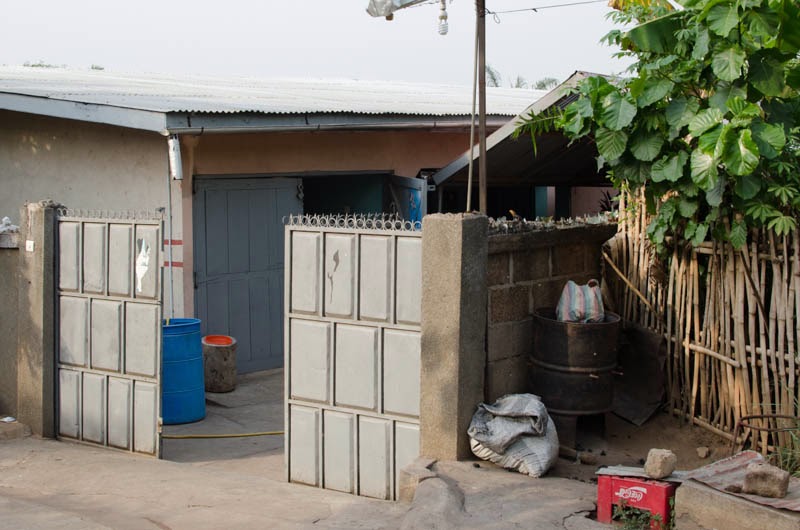
The entrance to my family's compound. The solid wood fufu mortar is next to the blue rain barrel (with an orange dish in it).
With the approval from the top level and the next level down, I will now be traveling to each of the Logba towns and villages (letting each one know when I'll be coming in advance) to meet with the people who have expressed interest in working with me. This will be the start of what is more conventionally considered to be 'language documentation' (of course, all of the preparation leading up to this is also an extremely important part of the work and is not to be dismissed as trivial! Planning, preparation, permissions, and getting to know people to a point of mutual trust and respect are also crucial to the work).
The view from across my family's cassava (and other things) garden to one of the peaks in the mountain range. The large palms are oil palms. I had palm fruit soup today with banku for lunch. The fronds are used for weaving and making hand-held brooms. The sap is tapped for palm wine and then distilled to make a local liquor (akpeteshie).  The fruit and nut are used for soup and oil. The oil can be used in making soap and 'red-red:' fried ripe plantains (which are red) with beans in palm oil (which is also red) - I had this for breakfast this morning. I have read that the husks of the fruit were previously charred and used to flavor water kept in tall ceramic containers with bulging bases and narrow necks (I would venture a guess that this maybe also contributed to purification of the water, but I am not an expert in this). The roots are used medicinally.
These are pretty powerful plants!

Since not (quite) all of my friends are linguists (I swear I have broad interests! Luckily, so do the bulk of my linguist friends), what is language documentation?

-eye stretch break-
Let me just pause for a second to admire the fact that about sixty feet outside my window a very large tree is blooming with triangular tufts of pink flowers. It is absolutely gorgeous!

Okay, language documentation is the documentation of language! This can involve written notes, audio recordings (on wax cylinders, as used to be done, or on SD cards, as is now becoming more common), video recordings (sign language research and gesture research make excellent use of this), and photographs to give context and visual referents. As we learned in the Plants Animals Words 2013 workshop, for plants a voucher specimen and botanical identification are also very important, and identifying animals can involve many things besides careful photographs, for instance information about behavior, flight patterns and wing shape (for birds), coloration, and scat.

Language is a powerful tool and it can be used to describe a diversity of experience in the natural (and supernatural!) world. Linguists are trained in many things, but by celebrating our own expertise and acknowledging our limits, we can benefit greatly from teaming up in a collaborative framework with many other experts, both from within the community in a participatory framework and also across disciplines in an interdisciplinary framework.

-ear break (do ears need to be stretched like eyes?)- 
There is a chorus of at least three completely different types of birds singing outside my window right now! And I think I hear my family preparing fufu...

Language documentation also includes a lot of metadata, which is information about the data, such as the names of those involved, how they were involved, the location, time, date, topic, equipment used, the languages included, and just about anything else you can think of to note that might be relevant either now or in the future. After my job working in the Endangered Languages Archive and going through the MA program in Language Documentation and Description, I now joke that, "I'm really not a fan of labels - but I do like metadata!"

Quick facts:

  • Not everyone who does language documentation is working with an endangered language. You can document languages considered stable or dominant, as well.
  • Not all languages are spoken. There are also sign languages, many of which are highly endangered. And there some amazing researchers whose focus is on documenting or advocating for these.
  • Not everyone who does language documentation is an 'outside researcher.' There are a growing number of people who are speakers (or heritage speakers, whose parents or grandparents may have been speakers even if they themselves are not fluent) of the language they are documenting. 
As for myself, I am definitely in the first camp, and this obviously has implications for the work I am doing. Though I have been invited to do this work by the paramount ruler, have been welcomed by the local rulers, and have been adopted into the royal family by the paramount ruler and his wife (four years ago), I am still an outsider in many many ways. I was not raised in the Logba Traditional Area, let alone in Ghana. I am still learning to speak the language (though as I keep trying, people tease me that I am already an "Akpanadze" or [female] Logba citizen). And my skin color is obviously very different, and with it comes all sorts of connotations. So I acknowledge this as I do my work and am educating myself on critical ways of approaching my research. I welcome critique from those with other perspectives and experiences than my own.

-smelling break! (don't 'break' your nose)- 
Outside my family's compound there are several sweet smelling trees, including Frangipani (Plumeria spp.) and also this one, which I believe is Ylang Ylang (Cananga odorata). In the evenings when there is a breeze its lovely scent wafts throughout the compound. I keep a few crushed up flowers by my bed.

Ylang Ylang tree (Cananga odorata) just outside my family's compound. In the evenings we often sit in chairs out here to enjoy the cool breeze and visit with neighbors who pass by.
Fruit of Cananga odorata
Flower of Cananga odorata.

I leave you now with a few more observations:

Women in transportation
In Accra just before I left, I rode for the first time in a trotro which had a female 'mate!' (Well, aside from the time in Kumasi when the mate was taken away by the police [both smiling and joking with each other] for trying to steal passengers from another trotro at a busy stop and my classmate, Rachel, happily took on the role of mate for the rest of the journey.) The mate is the person who calls out the destination of the trotro, collects money, and tells the driver when to 'bus stop' and then 'yenko!' ('Let's go!'). I also recently was beeped at by a female taxi driver - again, the first I'd seen in Ghana. Beeping at someone with your horn is usually a question, accompanied by a questioning hand gesture, meaning, 'Need a lift?' It is most frequently directed at those who look like the can afford a taxi, such as anyone in a suit or anyone who looks foreign (or exhausted by the heat!).

The cold
Up until recently I had never heard a Ghanaian in Ghana swear (at least not in English). What caused this sudden need for expletives? I was being told of the person's trip to London and how cold it had been! So cold that it made your hair stand on end. So cold that you had to wear thick socks under your shoes. So cold that you had to wear a warm hat with only your eyes and nose sticking out, and three layers of shirts with a jacket! -expletive expletive-

In contrast:
I was recently asked one evening, "Are you feeling cold?" (I was wearing shorts, a tank top, and sandals, and quite enjoyed the breeze!)
I couldn't help but laugh and laugh, then managed to reply, "I've just come from London!" Everyone joined me in laughter. They insist that if I wake up at 4:30am and go outside it will feel "cold like London!" but I've not yet tested this.

Okay my dears, that's all for now!

02 February, 2014

A fortnight in Accra, onward to the mountains!

Hello my dears, it has been a long time!

Just over four years ago I left Ghana with an invitation to return. Since then I have been working towards that aim, while also caring for myself, spending time with my loved ones, learning many new things, and doing what I can to enjoy my life!

But at last, I am here again. Akwaaba-oo!

Where am I and what am I doing, you may ask?

After two weeks in Accra, I am now in Logba Alakpeti, which is located in the mountains in the Volta Region. While Accra was too hot and dusty for my poor unacclimated self, Alakpeti is marvelously comfortable with lush greenery. It is not too hot, not too cold, and the humidity is just lovely. The family I am staying with are wonderful and I have a nice room with everything I need (bed, table, chair, and a fan). I'm very happy to be here!

I am here to continue a research project I started four years ago documenting plant names in Ikpána, this time for my PhD, as requested by the Unansanango (Paramount Ruler) of the Logba Traditional Area. The language, people and area are all called Logba by most people, but the autonymous terms are Ikpána for the language and Akpanawò for the people.

Since it is difficult to keep track of what I have told to whom, I will use my blog to try to update as many people as possible with occasional stories from my time here. Please feel free to make requests for anything you would like me to write about in more detail!

As a disclaimer, these stories are only my own observations and opinions and are not meant to reflect anything deeper or more insightful than that. I have only been to Ghana once before and am still a "baby to the system," as my friend Kofi puts it.

For this post, I will start with a few of the challenges I've faced and then move on to some of the exciting and fun things I have experienced in order to end on a positive note. I am grateful for both the challenges and the opportunities that have arisen during my time here so far.

Accra was difficult for me, as I generally don't find myself feeling very comfortable in cities. It was hotter than I remembered (harmattan winds!), which made it hard for me to sleep well at night, and I was usually covered in a thick coating of red dust from the minute I stepped out of my door. My long hair has been a new experience for me, because I had very short hair (and no hair!) when I was here last time, and washing long hair in a cold bucket bath is a skill I had not yet acquired (any tips are welcome).

My room in Accra and my badly set-up mosquito net! I miss the pop-up one I used to have, but thanks, Allanah, for giving me this one.


I had forgotten just how exhausting it is to be the only obruni (foreigner) in a market place, being shouted at, grabbed at, and stared at non-stop. I have learned that I much prefer being called to with "Sistah!" than "Obruni!" My Twi has declined rapidly in the four years I've been away and I felt very out of place, needing to rely almost entirely on the goodwill of other people to get around. Thankfully, the goodwill of people has turned out to be very strong!

From the moment I made it out of customs in the airport I have been in good hands as my Ghanaian friends have come to support me. Dear Joyce (and your family!), Clement, Nana Ama, Kofi, Ishmael, Ishmael's mum, Loretta, Rita, Mabel, Auntie Abigail and all the others, your kindness and generosity have meant so so much to me, so thank you!

As my supervisor reminded me, trusting in and even depending on others is something to embrace, rather than to fear. And as my dear friend, Angel, also reminded me, "These are rare moments in our lives and we would do well to cherish every moment however hot or uncomfortable." They are right, and it is with a good heart and an open mind that I come here.

On to some of the fun things!

My neighbors near Ritz Junction in Accra quickly became very dear friends of mine. In exchange for me teaching them to make pizza, they have been teaching me Twi (mostly be teasing me in it) and also how to prepare Ghanaian dishes.

Thanks to their family, I have now accomplished one of my life goals: I have learned to prepare kenkey!

Also, banku. Both are cooked doughs - kenkey (specifically, Ga kenkey) is made from fermented corn dough, balled up and wrapped in corn husks and banku is made from cassava dough mixed with fermented corn dough. Both are delicious! Banku must be swallowed, not chewed, and there seems to be some debate about whether kenkey is chewed or swallowed, but I think there was general agreement that it can be chewed. I have not tried pounding fufu yet as my neighbors think that it will make my hands rough and won't let me. I will try again...And Aunt Sylvia, I am working on getting you a video of some experts demonstrating how to pound fufu with great skill!

I am really enjoying fresh coconuts, sweet juicy mangoes, pineapple, and even some new fruits I haven't been able to look up yet because the internet is a bit slow. I drink Ghanaian cocoa every day (on its own). I'm only a bit pink from the sun after several long days being out in it for too long (thanks, coconut oil!) and am in good health, so I'm very grateful!

Sitting in the shade of a neem tree (azadirachta indica) with a gentle breeze, and sometimes the company of a friend, is a lovely way to study, it turns out. And I've been making new friends at the department of botany and the herbarium at the university, including a PhD student studying mycology (he says the university is hoping to create a microbiology department so he can go there rather than be studying fungi while lumped in with botany). There are some very kind people there who study ethnobotany and are documenting the usages of plants throughout Ghana (but have not yet worked in the Volta Region) and an expert in plant identification has agreed to come with me for part of my research to assist me with voucher specimen collection and identification of plants while I do my language documentation work. Hurray for collaboration in practice!

(Yes, Plants Animals Words 2013 friends, I am wearing my green hat with pride!)
drumming with new friends in Accra
(photo by Cat Hockings)


Mottos and advertising
As many of you know, shops and vehicles in Ghana often have a motto or a name reflecting something which the owner would like to share with the world.

A taxi on the way home from seeing Unansanango proclaimed:

Be fluent!

A passport photo business had a large sign by the road advertising themselves as "Gye Nyame ('accept God' though usually translated as 'except God') Passport Photos" with four photos of Obama smiling happily for his passport picture.

Today on my journey in a trotro (Ghana's convenient and affordable, privately-operated public transportation) to the Volta Region I passed by a shop which was named:

He is alive
fresh goat and cow meat

Okay my friends, that is a small update from me. I am doing well, learning a lot, and experiencing many new things. I hope that all of you are enjoying life and I'm always happy to hear from you!

22 October, 2013

Meet Alfred

I meant to post this ages ago, but here it is now. 

I found a little bug in the backyard at my home in Mayfield, NSW Australia one evening. The bug had such a unique expression that I couldn't help but take some photos. I also named it Alfred. 

The next day, in nearly the same spot, I found a bug that looked identical to Alfred except it was bright green instead of dull green. So either Alfred changed colors in the middle of the night or was replaced by a brighter doppelganger!


The next morning...


I looked up "winged insects of New South Wales" and found this excellent resource: http://www.ozanimals.com/australian-insect-index.html  

I dug though the most likely families (Orthoptera and Hemiptera) and found, under the "True Bugs of Australia" section, the Flatid Planthoppers, all of which look just like Alfred, but with a range of colors, from pale white with a pink spot (Mango Planthopper) to green with a border of reddish brown spots (Common Green Planthopper). 

Upon further reading, it appears that flatids go through five nymphal instars, which are developmental stages in between moltings on the way to reaching sexual maturity. Molting usually occurs at night or in the early morning and from one instar to another the flatid may change color or size, and may lose or gain a white powdery coating. So perhaps Alfred just molted and leveled up to the next nymphal instar . 

Also important to note, flatids are invasive in Hawai'i, but native to Australia and can be a vector of diseases. But look at that face... as one expert in cute bugs, (my friend) Dougal, has pointed out, "How could that bug invade anything? What does it do, run up to you, nuzzle your face and go eep?"

03 June, 2013

LJG's Gluten-Free ChiaFlax Bread

For all of those who suffer from a gluten intolerance or allergy, it can be incredibly difficult to find a loaf of gluten-free bread that doesn't taste like cardboard and doesn't cost $7 or more in the shop! So after months of trial and error, with input from friends and loved ones, here is a recipe that seems to turn out tasty each and every time and has only healthy, simple ingredients.

I'm not a professional baker, I just fiddle around in the kitchen until stuff tastes good to me. If you have suggestions for improving this recipe, please share them!

In the meantime, enjoy :)


Ingredients


¼ - ½ cup flax seeds, freshly ground
¼ cup chia seeds
2 cups water
--------------------
1 tsp dry active yeast
1 cup warm water
1 tsp honey
--------------------
4 ½ cups gluten-free flour blend
1 tsp salt
1 Tbsp caraway seeds, or other herbs (e.g. thyme, rosemary, and tarragon)
--------------------
2 Tbsp olive oil


Directions

Stage one (flax/chia):

Place flax, chia and water in jar and mix well. Leave in fridge at least four hours and up to five days (overnight is fine!).

Stage two (making dough):

Add yeast to warm water with honey stirred in (or skip this step if you don’t believe in proofing).
Put flour in mixing bowl, add salt and caraway seeds (or other herbs). Mix well.
Add olive oil, chia-flax mixture, and yeast mixture to dry ingredients and mix until there are no more lumps. Cover and let rise at least three hours, overnight in a cool place is fine. No need to knead! It will have a consistency like mousse after it rises – this is good.

Stage three (second rise):

Oil and flour two non-stick bread pans.
Split dough in half with spoon and gently scoop into the pans. Cover and let rise three-four hours (not more!).

Stage four (bake):

Preheat oven to 425°F (~220°C). Bake for 30 minutes. Do not open oven door until the very end or it will be ruined!

Lower temperature to 405°F (~200°C). Bake for 15-20 minutes, until golden brown. Remove from pans and let cool before slicing.


Notes
Flour blend: You can either buy a pre-mixed gluten-free flour blend or make your own from bulk flours you buy. Gluten-free flours that work well in a mix are millet, garbanzo, rice, sorghum (strong flavor!), buckwheat (also strong flavor!), fava bean, amaranth, quinoa, and potato.

Baking time: The baking time is entirely dependent on the amount of water in the recipe. If you add more water, you will have to bake it for longer or it will be doughy inside. Absolutely do not open the oven door while this is baking, or it will never get hot enough inside to cook all the way through! Add the extra baking time on at the end, after lowering the temperature.

Chia and Flax: These soaked seeds seem to be what gives the bread its structure in the way that gluten would have provided a structural network of support. They also happen to be highly nutritious, so that's a bonus. The idea for using them came from Celeste's cousin's husband, Sam, who is a professional baker - so credit goes to him for that one!

29 December, 2012

Zippered pouch

With all my stuff rattling around loose in my rucksack I decided I needed a zippered pouch to keep some knick-knacks in while traveling. A friend invited me to go to a fabric/craft shop with her to buy googly eyes, and seeing a shelf of discount fabric scraps I was inspired to make one myself.

So, I got half a yard of duck cloth (a thick canvas-like cloth) and a zipper, then began searching for suggestions on sewing one. I found several tutorials, such as this one about how to make a lined zippered pouch,and this one about how to make the corners look nice. Since duck cloth is pretty thick, lining didn't seem necessary, so I opted for a simpler style without it.

Dad dug up Grandma's old featherweight Singer sewing machine and I read the manual to familiarize myself with its use (been a few years since I used a sewing machine!). We dropped oil into every little nook the manual said to drip oil into and I did a quick practice run on a rag, then got to work. Without a lining, I could use the sewing machine to sew all three sides of the material to each other after sewing each to the zipper. With a lining, you have to leave a few inches unsewn then push the material right side out and sew the rest up by hand.
finished zippered pouch with mechanical pencil for size comparison

And the other nice thing about duck cloth: you can draw on it!
zippered pouch with colored pencil sketch

I'm pleased with it, and if I can find affordable zippers, I will be making more (zippers are so expensive!).